Alex Honnold’s True Brain: Neuroscience, Fear, and Human Flourishing
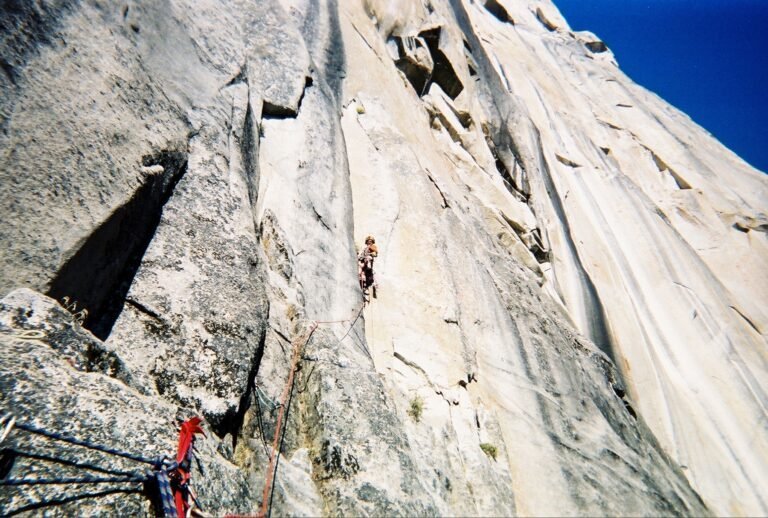
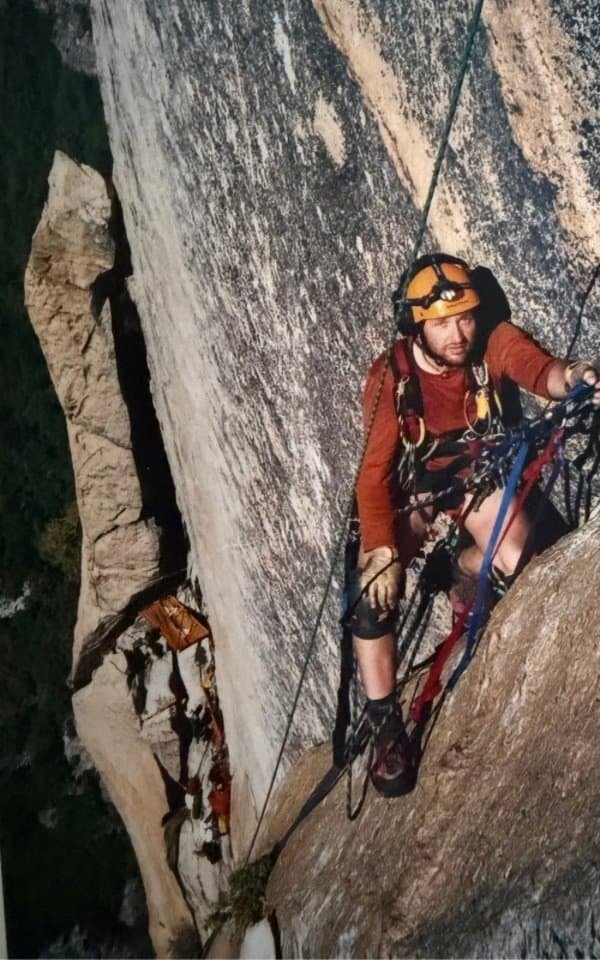
Shawn Kanin Desjardins climbing El Capitan, demonstrating human flourishing and optimisation.
What Neuroscience Actually Reveals About Human Flourishing When Alignment Is Intact
By Shawn Kanin Desjardins | Vessent Neuropsychology & Consciousness Research
How Alex Honnold- free solo climber isn’t neurologically broken — his “fearless brain” reflects fully aligned and calibrated performance. I know, because I’ve been there.
Why the “Fearless Brain” Narrative Persists
Thirty million people watched Alex Honnold climb Taipei 101 this weekend. Ropeless. Harnessless. Seventeen hundred feet of glass, steel, and wind, broadcast live on Netflix with no second takes and no safety net.
And somewhere in the back of everyone’s mind was the same question that has haunted Alex’s career since 2016: *What’s wrong with his brain?*
Let me give it to you straight. The truth that defies the narrative: Nothing.
Nothing is wrong with his brain. I can tell you this with certainty not just because I’ve studied the research and data, but because I’ve been exactly where he’s been. I know that stillness. I’ve lived inside that clarity. And as a neuropsychology researcher, I’ve mapped precisely what happens in the brain when that state occurs.
The neuroscientists examining Alex had the right data, though the framing of the question left the deeper insights about human consciousness and the mechanisms behind his so-called “fearless brain” out of reach. Firsthand experience can illuminate what the numbers alone cannot.
Scope Note: This article is not about a rare ‘fearless’ anomaly — it explores how calibrated, aligned, and systematic mechanisms govern human threat processing, as described by the Vessent framework. The common narrative oversimplifies Alex Honnold’s neural responses as ‘fearless’ — here, we expand understanding beyond that misconception.
My Firsthand Experience: Mapping Threat Response
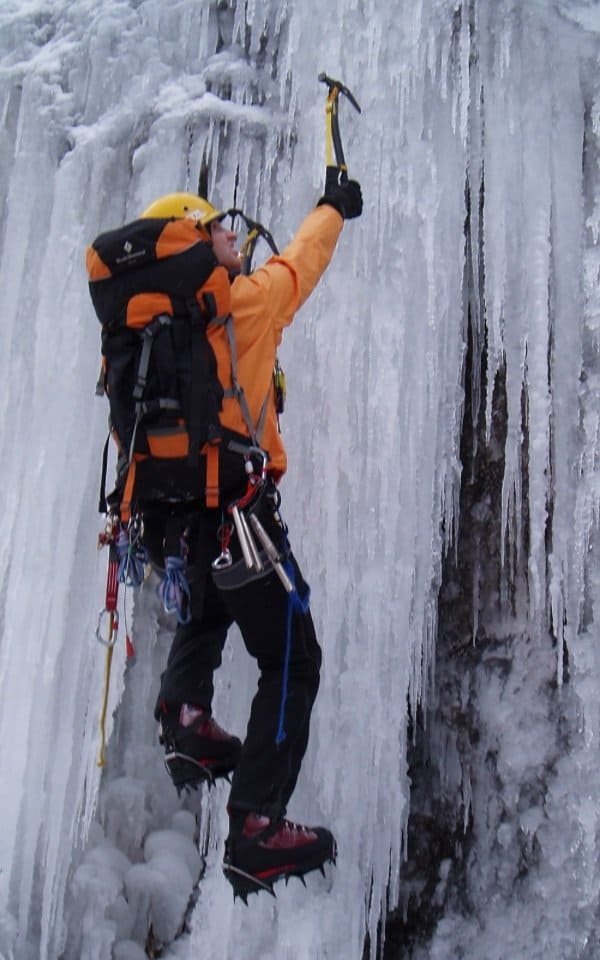
Shawn Kanin Desjardins soloing a committed alpine route in the Canadian Rockies
Years ago, on a committed alpine ice route high in the Canadian Rockies, the mountain unleashed her fury and I found myself in a position that should have killed me.
I was free soloing. No rope, no way back, no margin for error.
What started as one of the most magnificent climbing days of my career became something else entirely when conditions changed and retreat became impossible. My only escape was a traverse horror show that exceeded my technical ability, the exposure below me meant the tiniest mistake would obliterate my body beyond all recognition. Staying put was even more certain death.
By every metric that matters, I should have frozen. I should have panicked. The neurological cascade that accompanies mortal terror should have sent me into freefall off that wall. Loss of fine motor control. Tunnel vision. The desperate scrambling fight-or-flight that makes precise movement impossible.
Instead, something else happened.
Everything became still. Not calm in the way people use that word casually, but profoundly, intrinsically *still*. My mind spoke without chatter. Fear, as a felt experience, simply wasn’t there. What replaced it was a clarity so absolute that every micro-detail of the mountain became vivid and significant. The grain of the limestone. The thin sheen of ice. The precise distribution of my weight. The sequence of movements that would keep me alive unfolded without conscious thought. There was no thinking. Only knowing.
And something else. A feeling of total immersion, as though the boundary between myself and the mountain had dissolved. This was beyond flow state. I wasn’t climbing the rock. I was the climbing. Internal and external merged into a single experience where everything moved together in perfect coherence.
I climbed far beyond what I should have been capable of. Beyond what I would have thought possible for anyone. Near-vertical, sheer, featureless limestone, half-coated in a hair-thin veil of ice. Moves I had never attempted, on terrain I had never seen. Solutions I had never before imagined, executed with a precision born from every unconscious skill I had acquired over a lifetime.
When I finally topped out, hands trembling with delayed adrenaline, I sat on the precipice with a consuming question:
*Holy shit, how did I climb that and what just happened to me?*
That question never left. It eventually guided me through fifteen years of research. Not into the science of fear and threat response, but into the mechanisms of consciousness under extreme conditions. Into what allows human beings to flourish rather than merely survive. It led me to develop Vessent theory: a comprehensive model mapping the neurological architecture responsible for how human consciousness is processed and what happens when we stop disrupting it with misalignment and miscalibration.
The Vessent system encompasses nine interconnected subsystems, with threat assessment being just one. Yet this single mechanism illustrates beautifully how the entire architecture operates when functioning optimally.
So when I watched the coverage of Alex’s brain study and when I heard experts speculating about his “broken” amygdala, I didn’t just disagree.
I knew they were looking at it from a different direction entirely. Because I’ve lived the experience they were trying to explain. And I’ve mapped the neuroscience of what’s actually occurring.
I’m going to take you a little deeper than most blog articles, so if you just want the surface short version click here, but if you enjoy knowing more and expanding your knowledge, let’s go.
What the Data Actually Shows
“Alex Honnold’s nervous system is not ‘fearless’ — it is precisely calibrated and aligned to respond to real threat. Misinterpretations arise when the system is observed outside its operational context.”
In 2016, cognitive neuroscientist Dr. Jane Joseph slid Alex into an fMRI machine at the Medical University of South Carolina. She showed him a carefully curated sequence of images designed to provoke fear and arousal: gore, corpses, disturbing content that reliably lights up the amygdala in virtually every human brain given this test.
Alex’s amygdala showed nothing. Zero activation.
A control subject, another experienced rock climber of similar age (but different disposition), lit up like a Christmas tree under identical conditions. Alex’s brain remained quiet, as though he were looking at landscape photographs.
Joseph called it unprecedented. “Maybe his amygdala isn’t firing,” she speculated. “He’s having no internal reactions to these stimuli.”
When the legendary fear researcher Joseph LeDoux at NYU reviewed the findings, he expressed bewilderment. In decades of studying the amygdala, he had “never heard of anyone with a normal amygdala showing no activation.”
That is all the media needed to hear and they ran with it. *Free Solo*, the Oscar-winning documentary, featured the brain scan footage. The takeaway that rippled through public consciousness was clear: **Alex Honnold must have a broken fear response.** Something anatomically different. A neurological mutation that makes him capable of what would mentally destroy the rest of us.
Sensational. Headline-grabbing. And a fundamental misreading of the data. More importantly, a disservice to everyone.
Understanding the Amygdala: Threat vs Danger
Here is what that interpretation failed to account for: the amygdala does not fire at danger. It fires at perceived threat under conditions of uncertainty.
This distinction is paramount.
The amygdala’s primary function is not to register objective risk. It flags situations where the organism lacks sufficient data or capability to guarantee survival. It is an uncertainty detector, not a danger detector. When you encounter a novel situation with unknown parameters and unproven ability to navigate it, the amygdala sounds the alarm. Cortisol floods the system. The sympathetic nervous system activates. You experience what we call fear.
But here is what happens when you systematically expose yourself to a category of experience, building genuine competence through deliberate practice: the uncertainty dissolves. Your nervous system accumulates evidence through successful navigation, proven capability, and repeated survival, then updates its threat model accordingly.
The amygdala does not fire because there is nothing to flag. The organism has data. The situation is not uncertain anymore.
This requires understanding the amygdala’s actual function rather than the simplified “fear centre” model that dominates popular understanding. Joseph LeDoux’s own research distinguishes between automatic defence responses and conscious fear feelings. The amygdala mediates the former; the latter involves cortical elaboration. What Alex demonstrates, and what I’ve experienced, is a nervous system that has aligned its threat detection based on accumulated evidence.
Consider the experimental conditions: Alex, a man who has literally hung by his fingertips 3,000 feet above the Yosemite Valley floor with no rope, was shown photographs while lying safely inside a medical imaging tube.
Pictures. On a screen. From a horizontal position.
More importantly, Alex has spent considerable time, as I have ( but not every climber ), visualising your demise most graphically. I can’t speak for Alex but for myself it’s a visualisation so graphic it becomes repellant, something so horrific you will do whatever it takes to prevent it from happening.
For someone whose nervous system has been calibrated through thousands of hours of actual exposure to life-or-death situations, and hours of graphic imagery of one’s own demise, why would photographs register as threatening? His brain correctly assessed: This is not dangerous. No response required.
Alex’s own reaction to the lab images is telling: he described the stimuli as simply “black and white photos,” noting that, lying safely inside the scanner, the experience “wasn’t scary” to him at all. Further, he suggested if there was a snake in the tube he was sure it would have lit him up.
That is not dysfunction. That is precise threat assessment. That is an aligned and calibrated system doing exactly what it was developed to do.
Understanding why his system works so well requires a framework that neuroscience had not yet provided. That is where my research comes in.
Vessent Framework: How Human Consciousness Aligns & What That Means for Human Flourishing
My research has focused on mapping the mechanisms of human flourishing—specifically, what allows some individuals to operate with clarity and coherence while others remain trapped in chronic stress, misaligned responses, and persistent internal conflict.
Vessent theory proposes that human consciousness includes an integrated evaluative system: a network of neural subsystems continuously assessing alignment between lived experience and authentic organising principles.
Within this framework, I have identified three systemic configurations: calibration, alignment, and authenticity. The relationship between these determines whether the organism operates optimally or falls into dysfunction. The full architecture of their interaction extends far beyond the scope of this article.
For understanding Alex, only this matters: when these three converge, the system functions optimally. Threat detection becomes accurate. Fear responds proportionally to real danger. And the system provides feedback that supports the organism in flourishing.
Dysfunction arises when convergence is disrupted. This can occur when genuine attractions are overridden, when pursued paths conflict with core organising principles, or when external conditioning introduces contradictory signals into the system, among many other causes not addressed here.
It is important to note that most people begin with reasonably accurate baseline calibration. The human nervous system, even when out of calibration, is not fundamentally broken. What typically produces dysfunction falls into one of two patterns:
Miscalibration (often trauma-induced):
Intense negative experiences can distort the threat-detection system, producing hypersensitivity and false positives. The amygdala fires at shadows because it was once burned by real danger. This is a genuine calibration issue as the configuration itself has been altered.
Conditioned misalignment:
Being repeatedly told something is dangerous when lived experience indicates otherwise. Having natural attractions systematically discouraged. Receiving contradictory inputs that confuse the system’s signalling. In this case, calibration remains intact. The system is functioning correctly but operating on corrupted data.
To illustrate, consider another domain I know intimately: horse training (cross species example is illustrative only) An untrained horse bolting at a plastic bag is not miscalibrated—it is misaligned. The response does not match reality, but the underlying mechanism functions as intended. Through systematic exposure, the horse reassesses, recognises that the bag is not a threat, and updates its response. Alignment is restored.
A police horse standing calmly amid gunfire, crowds, and chaos is not neurologically different from other horses. Its system is accurately calibrated and aligned because it has learned, through evidence, what constitutes threat within its operating environment. Just as some horses are better suited to high-performance roles, some people are as well. The system is shared, but expression varies.
Alex is not a genetic anomaly. He demonstrates what occurs when calibration and alignment operate correctly at a high level. He followed his authentic attraction to climbing without overriding internal signals. He systematically expanded his capacity through thousands of hours of deliberate preparation. His nervous system recalibrated based on evidence.
The brain scan did not reveal dysfunction. It revealed a system operating exactly as it was developed to.
First-Person Insights: Alex Honnold on Threat
“I would suspect that your amygdala probably responds less to fear than the average person… You’re just not going to respond to stimulus in the same way.”
Alex has been pushing back on the “broken brain” interpretation for years. Most people just weren’t listening because his explanation doesn’t make for sensational headlines.
But I hear you, Alex. You’re optimal, not broken.
In a recent interview with Jay Shetty ahead of the Taipei 101 climb, he addressed the brain study directly:
“I would suspect that your amygdala probably responds less to fear than the average person. Just in the same way, years of meditation will do the same thing. You’re just not going to respond to stimulus in the same way. For me, I’ve been consistently experiencing fear all the time as a climber for years. And so the test they did—you’re in an fMRI, looking at black and white photos, lying down inside a sealed tube—is just not scary.”
He continued with something crucial:
“It’s a shame because there’s a scene in *Free Solo* where they show a little clip from that, and basically everyone watching the movie comes out thinking, ‘Well, there’s something wrong with his brain.’ And you’re like, no. The takeaway is that if you practice something your whole life, you get better at it. That’s the real lesson.”
This aligns precisely with what the neuroscience actually shows and what Vessent theory predicts. The nervous system is plastic. It updates based on evidence. Repeated exposure to a category of experience, successfully navigated, recalibrates threat assessment for that category.
Alex isn’t describing the absence of a fear response. He’s describing a *precise* fear response, one that correctly distinguishes between genuine threat and mere stimulus.
Aligned Operational State: The Phenomenology of Alignment
Let me articulate what this state actually is from the inside, because understanding the phenomenology is essential to understanding the neuroscience.
In ordinary consciousness, there is a constant background hum of mental chatter—thoughts about the past, projections about the future, self-referential evaluation, and commentary on experience. Most people do not notice this noise because it is so constant, like not hearing an air conditioner until it shuts off.
In the state I’m describing, that hum quiets dramatically.
What remains is direct perception—unmediated by narrative, unfiltered by self-referential thinking. You’re not thinking about what you’re doing; you’re simply doing. You’re not evaluating your performance; you’re simply performing. Past and future converge into a single expanding present that contains everything necessary and nothing extraneous.
Neurologically, activation patterns shift: the default mode network, associated with self-referential thought and mental time travel, quiets, while task-positive networks, linked to present-moment engagement and skilled action, dominate. The prefrontal cortex maintains executive function without interference from threat-activated emotional flooding.
Every sensory detail becomes vivid and significant—the texture of rock, the sound of breath, the subtle shifts of weight and balance. You’re not monitoring these consciously because that would be too slow; you’re simply aware of them, integrated into seamless action and response.
Consequences, even potentially fatal ones, do not create fear because they are experienced as parameters to work within, not future events to worry about. The way a chess master accounts for an opponent’s pieces without fear is a similar example.
This is Partial Flow—the nervous system functioning properly, aligned and calibrated, providing the foundation that makes higher mastery and full flow states possible. Alex demonstrates this baseline state on the wall, and it is what the neuroscientists could not measure with imaging alone. They were studying hardware without accounting for the software—the integrated system in action.
How Neural Systems Work Together
There is another dimension the original research touched on but did not fully explore: the relationship between the prefrontal cortex and what is often called the limbic system. Modern neuroscience has largely dismantled it as a unified concept, and my research suggests these structures actually form part of the larger Vessent system. But that is a topic for another article.
Jane Joseph noted that Alex might have “a well-honed regulatory system” with “a powerful frontal cortex that calms him down.” This observation points toward something important, but the framing is off.
Alex’s prefrontal cortex is not suppressing his amygdala, white-knuckling fear into submission through sheer cognitive override. That model of emotion regulation is exhausting and unsustainable. You cannot suppress your way to peak performance.
What the research actually suggests is a *collaborative* relationship between these systems. The prefrontal cortex is not fighting the amygdala; it is *informing* it. Through deliberate practice, mental rehearsal, and systematic exposure, Alex has trained his threat-detection system to trust his capability assessment.
The prefrontal cortex communicates: “I’ve analysed this route. I’ve climbed it with protection dozens of times. I know every hold. The body knows these movements.” In simpler terms, and as was the case in my own experience, it simply says: “You’ve got this. You’re capable. You can handle whatever comes.”
The amygdala, receiving this data, responds appropriately: “No uncertainty detected. No alarm required.”
This only works when the information is authentic and true. I can’t simply convince myself I can climb what Alex climbs. That wouldn’t be alignment. It would be delusion. The system has integrity.
LeDoux himself touches on this interpretation: “By self-exposing, training himself in those situations, he’s going to reduce the amygdala activity, because that’s what exposure does.”
But he framed it as Alex “reducing” something, as if the baseline state were high activation and Alex had found a way to diminish it. The Vessent framework suggests the opposite: high activation in the absence of real threat is the deviation. Alex’s quiet amygdala is not reduced. It is *correctly tuned*.
Lessons From Threat: Alignment Over Suppression
There is a misconception that Alex, or anyone who operates in this state, must have been “born fearless.” That we were somehow different from childhood, unable to feel what others feel.
The evidence suggests otherwise.
In the early years, before thousands of hours of climbing and systematic exposure to increasingly challenging terrain, Alex would have experienced fear like anyone else. I certainly did. The shaking hands. The dry mouth. The voice cataloguing everything that could go wrong.
That is the system working correctly. Before you have data about your actual capabilities, fear serves a protective function. It keeps you conservative while you are learning. It creates caution during the vulnerable acquisition phase.
What distinguishes people who eventually reach that state of operational stillness is not the absence of early fear. It is that we didn’t let it override authentic attraction. We interpreted fear not as a signal to stop, but as a signal to prepare. To earn, through deliberate practice, the neural quietude that comes from genuine mastery.
Extreme performers make architecture visible. They are not the sole purpose of the system.
Alex did not start by free soloing El Capitan. He climbed it with ropes first. Many times. He took meticulous notes. He visualised every sequence until his body knew the terrain like familiar ground.
By the time he climbed ropeless, his nervous system had evidence. Proof that these particular movements, on these particular holds, were within his demonstrated capability. The fear stepped aside because there was nothing left to flag.
Alex didn’t override his Vessent feedback. He embraced it.
Applying Vessent to Everyday Life
Here is why this matters beyond the extraordinary cases of elite climbers.
Most people live with internal signalling systems that are misaligned. Not broken. Not fundamentally miscalibrated. Just responding to threats that do not exist while simultaneously desensitised to real dangers they have normalised.
We fear public speaking more than car accidents, despite the statistical absurdity. We feel anxiety about social rejection while ignoring chronic stress that is actually killing us. We override authentic attractions, the pursuits that genuinely call to us, because we have been conditioned to believe they are unrealistic or dangerous or impractical.
Consider Oprah Winfrey. Early in her career, she was demoted from her position as a news anchor at WJZ-TV in Baltimore. Her bosses told her she was “unfit for television news” because she got too emotionally invested in her stories. She was told to suppress what came naturally. When she was moved to a daytime talk show as a consolation, something shifted. The format allowed her to be herself. What her news directors had seen as a weakness became her greatest asset. Viewers connected with her authenticity. That “demotion” led directly to The Oprah Winfrey Show and a media empire worth billions. Her system had been signalling all along that news anchoring wasn’t her path. When she stopped overriding that signal, everything aligned.
Then we wonder why we feel perpetually out of sync with ourselves. Why we achieve what we are supposed to achieve and still feel hollow. Why our nervous systems constantly signal alarm in situations that should feel manageable.
The system isn’t broken. It is trying to tell us something.
The path forward involves three elements:
- Authentic alignment. Identify and pursue what genuinely calls to you rather than overriding that signal. Chronic anxiety often signals misalignment rather than danger.
- Systematic competence. Expand capability through deliberate practice rather than reckless exposure. Build mastery that justifies recalibrated confidence.
- Trust the feedback. Allow your nervous system to update based on evidence. Release fears that served you at earlier developmental stages but no longer match your actual capabilities.
The View From the Top
After completing the Taipei 101 climb at 1,667 feet in 91 minutes with no ropes, Alex’s first words were not about triumph or conquest.
“What a view! It’s incredible! What a beautiful day!”
And then, characteristically practical: “It was very windy, so I was like, ‘Don’t fall off the spire.'”
I smiled watching it. That’s exactly right. Classic.
Consciousness operating in its natural state. Not numbed. Not broken. Not artificially calm through suppression. Simply attuned, responding to actual circumstances with appropriate awareness.
Full presence to experience, including beauty. Full awareness of reality, including risk. No wasted energy on manufactured fear.
I know that state. I’ve stood on summits and felt that same appreciation. Not relief at survival, but gratitude for the precision and presence the journey required. For the privilege of operating at the edge of capability where everything becomes vivid and nothing is wasted.
A Different Question
The neuroscience community looked at Alex Honnold and asked: What is different about his brain that allows him to do what would destroy the rest of us?
The better question, the one my research has pursued: What allowed his brain to correctly reflect his actual capabilities?
Some think the answer is genetic advantage. The real answer is alignment with authentic purpose, pursued without override. Competence built through systematic preparation. A nervous system allowed to calibrate based on evidence rather than inherited fear. Learning to listen to the internal feedback and allowing oneself to flourish without getting in the way.
That is not a broken fear response. That is the system operating as it should, protecting us from real threats while stepping aside when we have proven, through action, that we know what we are doing.
Alex’s quiet amygdala is an invitation to understand what becomes possible when we stop fighting our own architecture and start collaborating with it.
This article isolates one visible mechanism: threat calibration under extreme conditions. It does not address the full architecture governing identity, motivation, emotional signalling, or long-term trajectory regulation. Those mechanisms operate continuously, even when no danger is present. The Vessent system maps how this works, not just for threat response but across the full spectrum of human flourishing.
That stillness Alex knows? The clarity I found on that alpine wall?
It’s not reserved for the extreme few. It is what calibrated, aligned consciousness actually feels like.
And it’s waiting.
Frequently Asked Questions
Q1: Is Alex Honnold’s brain actually fearless?
No. Alex’s brain is not fearless. His nervous system is finely calibrated to distinguish genuine threats from non-threats. What appears as fearlessness is actually precise threat detection in action, shaped by years of experience, preparation, and alignment with his authentic skills and purpose.
Q2: How does the amygdala factor into fear?
The amygdala is just one part of a larger neural architecture that processes what we call fear. It primarily responds to uncertainty or perceived threat, not objective danger. In Alex’s case, his amygdala is functioning normally within a broader system that has been finely tuned through experience and alignment.
Q3: Does everyone have the potential for this kind of alignment?
Yes. The human nervous system is adaptable. By cultivating calibration, alignment, and authentic engagement with experiences, anyone can develop clarity, precise threat assessment, and functional fear responses. This is the principle behind the Vessent framework.
Q4: What is the difference between miscalibration and misalignment?
Miscalibration happens when your nervous system interprets signals incorrectly from internal or external influences. Misalignment occurs when your actions framing or responses don’t match your deeper organising principles. Neither indicates a broken system—they are signals your body is trying to communicate.
Q5: Can these principles apply outside extreme climbing?
Absolutely. Calibration and alignment govern all human performance and flourishing. They apply to professional life, relationships, skill mastery, and personal growth. Understanding how your system signals and responds allows you to act with clarity, precision, and purpose in any context.
Q6: Is fear suppression ever useful?
Suppressing fear is not effective. True mastery involves acknowledging signals, aligning actions with authentic capacity, and alignment based on evidence. Suppression bypasses the system and can lead to stress, misjudgment, burnout, injury or death.
You just read 3,000 words on neuropsychology. That’s not casual scrolling—that’s your commitment to mastery. The complete Vessent framework launches soon. Reserve early access here.
Shawn Kanin Desjardins is a neuropsychology researcher, consciousness theorist, and founder of Vessent, a model mapping the neurological architecture responsible for human flourishing and authentic peak performance. His research into calibration, alignment, and optimal consciousness function emerged from direct experience in extreme environments: world-class alpine climbing across the Rockies, Andes, and Yosemite; commercial diving; high-angle rescue operations; emergency response; and trauma therapy practice. This combination of rigorous scientific investigation and firsthand phenomenological data gives his work a unique foundation, theory built on both laboratory research and lived experience at the edge of human capability.
To learn more about the Vessent and our research click here
To share a simpler article of this you can find it here